
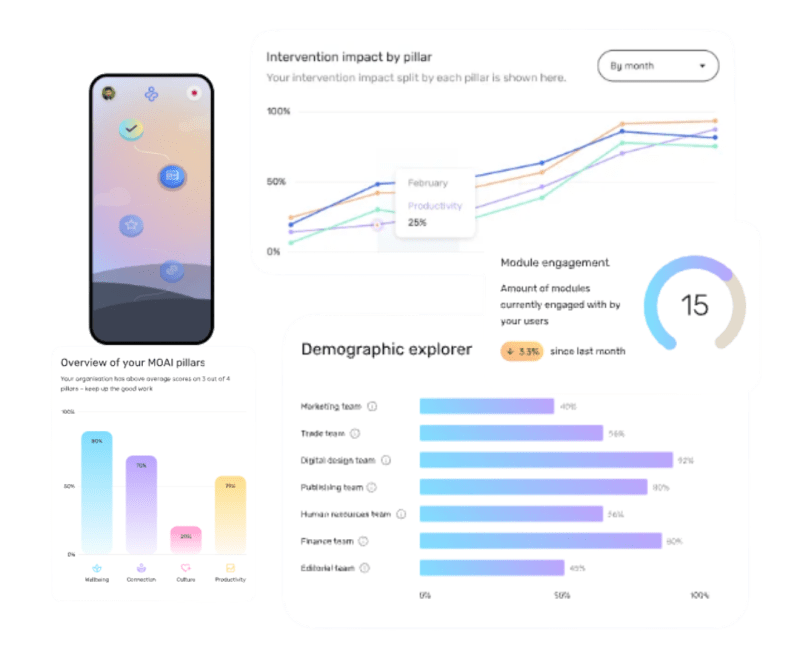
Measuring wellbeing tells you people are struggling. Pulse Check tells you why.
MOAI Pulse Check goes beyond traditional wellbeing measures to help you understand how your people are doing and, if they are struggling, why that may be.
It does this by identifying and measuring psychosocial risk factors across your organisation. Only when you understand which aspects of working life might be driving poor mental health are you able to make meaningful changes.
Assessing and managing psychosocial risks is also a legal requirement under health and safety legislation. By assessing wellbeing and psychosocial risks together, you’re able to demonstrate compliance and commitment to creating a safe, supportive workplace.

Understand the wellbeing challenges your people may be facing
Develop a mental health and wellbeing strategy that’s driven by data and insight

Identify the most common workplace psychosocial risk factors within your organisation

Assess the effectiveness of your current wellbeing activity


What are psychosocial risks?
Psychosocial risk factors are the parts of day-to-day life that, over time, can contribute or protect us from mental health problems. These can include social factors (such as loneliness), physical factors (such as sleep and exercise) and workplace factors (such as job security).
MOAI Pulse Check is grounded in international health and safety guidelines



What MOAI Pulse Check Measures
MOAI Pulse Check considers the health of your whole organisation, assessing risk factors at the individual, group and organisational level.

Workplace Risk Factors
Workplace Risk Factors
Workplace risk factors are the day-to-day parts of working life which can cause stress, strain and mental ill health. These include:
High workload
Tight deadlines
Lack of clarity and demands
No autonomy
Poor communication
Job insecurity
Bullying and harassment

Individual Risk Factors
Individual Risk Factors
Individual risk factors are factors outside of the workplace which can have a negative impact on mental health. We don’t focus on risk factors we cannot change, such as genetics or demographics, instead we focus on areas where there is opportunity for change. These include:
Sleep
Exercise
Loneliness
Self-compassion

Wellbeing Measures
Wellbeing Measures
Wellbeing measures assess how an individual is doing right now. Not all psychosocial risks are visible, so these measures will help to identify individuals and teams in need of urgent support. Measuresl include:
Role satisfaction
Anxiety
Mood
Loneliness
Autonomy
Communication

What’s included
In your Pulse Check assessment?
Understanding you, your challenges and your people

Through a series of interactive workshops with key stakeholders we will develop a deep understanding of:
- Current challenges facing your industry
- Your organisation, including any recent or upcoming changes
- Specific challenges your people are facing
- Organisational structure, job roles and responsibilities
- Specific goals
Mapping your risk factors to design a highly effective survey

Armed with a clear brief of what we want to achieve, we’ll develop a tailored anonymous digital survey. This will cover a number of key areas including:
- Demographics
- Individual wellbeing measures
- Individual risk factors
- Workplace risk factors
- Outcomes
Survey launch and employee engagement

To help you achieve maximum levels of engagement, we will provide you with everything you need to launch the survey and gather data. This will include:
- Language and imagery
- Links and QR codes
- Specific assets for managers and leaders to share
- Suggestions for managers and leaders on how to drive engagement
Your final report and interactive presentation

Once your data has been thoroughly cleaned and anonymised, our experts will analyse your data and provide you with a final report. This will include at least two methods of analysis.
A final report will be presented to key stakeholders by a psychiatrists or psychologist, and you will have the opportunity to discuss the findings from the audit, and explore the most suitable evidence based interventions.

